 how-to
24 Hour Notary Near Me: How to Get One Fast
Table of Contents
- How to Find a 24 Hour Notary Near Me
- How Mobile Notary Public Services Work
- How to Prepare for a Notary Appointment
- Notary Public Identification Requirements
- Documents That Need a Notary
- After-Hours, Weekend, and Emergency Notary Service
- Online vs. In-Person Notarization: What's Legal?
- Pricing and Fee Structures for Mobile Notaries
- Frequently Asked Questions
Last Updated: September 25, 2026
How to Find a 24 Hour Notary Near Me
Finding a 24 hour notary near me starts with verifying credentials, confirming the service area, and understanding fees before you book. David Booth Mobile Notary handles after-hours signings across Tennessee and Virginia.
Verify Credentials Before You Book
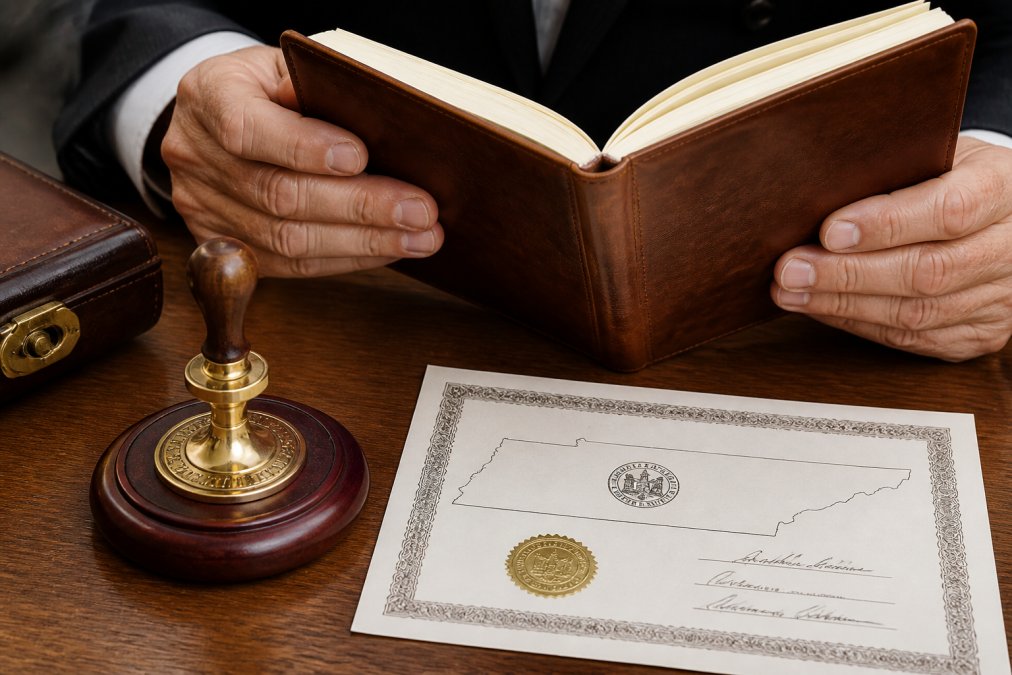
A commissioned notary in Tennessee or Virginia must hold an active commission, a surety bond, and a valid seal. Ask for the commission number and expiration date before booking.
Three checks take under two minutes:
- Confirm the commission is active through the state's notary database
- Ask whether the notary carries errors and omissions insurance
- Verify the notary is a certified loan signing agent if your documents involve real estate
Service Areas and Travel Fees
Mobile notaries charge a base notarial fee plus a travel fee, typically per mile or as a flat zone-based rate. Rural counties often fall outside a provider's standard service radius, so ask: Do you cover my county, and is there a minimum call-out fee for after-hours travel?
How Mobile Notary Public Services Work
Mobile notary public services bring a commissioned notary to your home, hospital, office, or care facility. The notary travels to you, verifies identity, witnesses the signing, and applies the seal on the spot.
The process is straightforward:
- Call or book online and describe the document type
- Confirm the appointment time and location
- Have your government-issued ID and unsigned documents ready
- The notary arrives, verifies identity, and witnesses each signature
- The notary completes the acknowledgment or jurat certificate and applies the seal
What to Expect at Your Appointment
The notary will ask for your ID, confirm you're signing willingly, and watch you sign. For an acknowledgment, the notary certifies you appeared before them and acknowledged the signature as yours. For a jurat, the notary administers an oath and certifies you signed in their presence. A standard document takes ten to twenty minutes; multiple documents or witnesses take longer.
How to Prepare for a Notary Appointment
Preparation is the difference between a five-minute signing and a wasted trip. The most common mistake is arriving with documents already signed, which invalidates the notarial act.
- Confirm the document is unsigned and undated
- Gather valid, unexpired government-issued photo ID
- Bring any witnesses the document requires
- Have payment ready for the notarial fee and travel fee
- Check that blank spaces are filled in before signing
- Confirm the appointment address and parking access
Emergency Document Checklist
Emergency notarizations usually involve time-sensitive documents. Keep this list ready when you need a 24 hour notary at short notice:
- Power of attorney
- Advance healthcare directive or living will
- Real estate closing documents
- Affidavit or sworn statement
- Trust or estate amendment
- Loan signing package
Notary Public Identification Requirements
Notary public identification requirements in Tennessee and Virginia center on one thing: a current, government-issued photo ID, a state driver's license, U.S. passport, state-issued ID card, or military ID.
Documents That Need a Notary
Not every document requires notarization, but the ones that do tend to be legally significant. Common examples include:
- Power of attorney granting someone authority over your finances or healthcare
- Real estate closing documents, including deeds and mortgage papers
- Wills and trusts, when state law or the drafter requires a notarial act
- Affidavits used in court or government filings
- Certified copies of certain records, where a notary is authorized to certify
After-Hours, Weekend, and Emergency Notary Service
After-hours service is where most providers quietly fall short. A genuine 24-hour notary answers the phone at 2 a.m. and can be at your door within a reasonable window. The difference between a smooth emergency signing and a wasted night comes down to the first five minutes of the call.
What Counts as an Emergency Notarization
Emergency notary situations typically involve:
- Hospital or hospice signings where a patient's condition is time-sensitive
- Real estate closings with a hard deadline the next morning
- Court filings due before a weekend
- Estate documents that must be executed before a family member travels
- Loan modification or forbearance paperwork with a same-day deadline
- Guardianship or custody paperwork tied to a court date
If your document falls outside this list, it may still qualify for after-hours service, but expect the provider to ask why it can't wait until morning. A legitimate notary uses that question to prioritize true emergencies, not to turn away business.
The Intake Call: What a Real 24-Hour Notary Asks
When you reach a genuine after-hours notary, the call follows a predictable pattern. Expect to be asked:
- Document type, power of attorney, deed, affidavit, loan package, or something else. This determines whether the notary needs to be a certified loan signing agent.
- Signer condition, is the signer alert, able to hold a pen, and able to communicate? A notary cannot proceed if the signer appears incapacitated or is signing under duress.
- Exact address and access, hospital room number, gate code, unit number, parking situation. A notary who doesn't ask for access details will lose time on arrival.
- Witness requirement, does the document need one or two witnesses, and will you provide them or does the notary need to bring them?
- ID status, does the signer have a current, unexpired government-issued photo ID in hand?
- Deadline, when does the document need to be executed, and is there a courier or filing cutoff?
Realistic Arrival Windows
After-hours arrival times vary by market and distance, but a common pattern is:
- Metro areas: 45 to 90 minutes from the time the appointment is confirmed
- Suburban areas: 60 to 120 minutes
- Rural counties: 90 minutes to several hours, and some providers won't travel at all after dark
Emergency Document Checklist
Emergency notarizations usually involve time-sensitive documents. Keep this list ready when you need a 24 hour notary at short notice:
- Power of attorney
- Advance healthcare directive or living will
- Real estate closing documents
- Affidavit or sworn statement
- Trust or estate amendment
- Loan signing package
- Consent-to-treat or guardianship paperwork
- Vehicle title transfer or release of lien
When the First Notary Can't Come
- Ask about a morning slot. If the deadline allows, a 7 a.m. appointment is often easier to fill than a 2 a.m. one and may cost less.
- Check whether the document accepts remote online notarization. Some emergency documents, affidavits, certain powers of attorney, and some lender packages, can be completed online in minutes if the signer has a device and a connection.
- Call the receiving party. If a court, lender, or title company set the deadline, ask whether a next-business-day signing will still work. Deadlines are sometimes softer than they appear.
- Use a credible witness. If the signer lacks ID, some jurisdictions allow a person who knows the signer to vouch for their identity. Rules vary, so confirm with the notary before relying on this.
David Booth Mobile Notary offers emergency service and after-hours availability across Tennessee and Virginia, including bedside visits at care facilities and in-home signings for elderly clients who need extra time.
Online vs. In-Person Notarization: What's Legal?
Remote online notarization (RON) is legal in many states, but not all, and isn't accepted for every document type. RON uses audio-video technology and identity verification to complete a notarial act without the signer and notary in the same room.
Pricing and Fee Structures for Mobile Notaries
Mobile notary pricing depends on document type, time of day, and distance traveled. Most providers separate the state-capped notarial fee from the travel and convenience fee, the most important thing to understand before booking an after-hours signing.
The Two-Part Fee Structure
Every mobile notary quote breaks into two buckets:
| Fee Type | What It Covers | How It's Set |
|---|---|---|
| Notarial act fee | The signature, oath, acknowledgment, or jurat | Capped by state law |
| Travel and convenience fee | Mileage, drive time, after-hours availability, and the notary coming to you | Set by the provider |
The notarial act fee is the only part most states regulate. In Tennessee and Virginia, the maximum per notarial act is set by statute, a modest per-signature or per-document amount. Everything else, travel, late-night call-out, rush, falls under the provider's own pricing.
What Drives the Total Cost
Four variables move the number the most:
- Distance. Travel is usually quoted per mile or as a flat zone-based rate. A signing two miles away and one forty miles away are not the same job.
- Time of day. Evening, overnight, weekend, and holiday calls typically carry an after-hours surcharge. The later the call, the higher the surcharge.
- Document complexity. A single acknowledgment takes minutes; a full loan signing package with dozens of signature lines can take an hour or more and is priced accordingly.
- Number of signers. Two signers on one document usually means two notarial acts, which means two state-capped fees plus the same travel fee.
Questions to Ask Before You Book
A transparent provider will answer all of these without hesitation:
- What is the total cost, all-in, including after-hours and travel?
- Is the travel fee per mile or a flat zone rate, and does it change after dark?
- Is there a minimum call-out fee?
- Is there an additional charge per signature or per document?
- Do you charge for a second signer or for witnesses?
- What happens if I need to reschedule or cancel?
- Do you accept card payment, or is cash or a transfer required?
Why After-Hours Costs More
An after-hours surcharge isn't arbitrary. A notary taking a 2 a.m. call gives up sleep, drives on empty roads, and often rearranges the next day. The surcharge compensates for availability, not the notarial act itself, which is why it's provider-set rather than state-capped. That also means it's sometimes negotiable: if your deadline is flexible by a few hours, a 6 a.m. or 7 a.m. slot instead of 2 a.m. can meaningfully reduce the total.
How to Avoid Surprise Charges
- Get the total in writing, text or email, before the notary leaves for your location.
- Confirm the document count. If you tell the notary "one document" and hand over five, expect the price to change.
- Have payment ready. Many after-hours notaries won't accept personal checks and may not have a card reader on them.
- Ask about the return trip. If the notary has to drive back through a toll or a long rural route, some providers fold that into the travel fee and some don't.
David Booth Mobile Notary confirms pricing when you call, so you know the total before the notary arrives. To book a signing, call now and describe your document and location.
Frequently Asked Questions
Is a notary available 24 hours?
Not all notaries offer 24-hour service, but some mobile notary public services do. Availability depends on the provider's schedule and your location. When searching for a 24 hour notary near me, call ahead to confirm they can reach you at the time you need. David Booth Mobile Notary serves Tennessee and Virginia with 24/7 availability, so you can book an appointment even late at night or on weekends.
How do I prepare for a notary appointment?
To prepare for a notary appointment, gather your unsigned document, a valid government-issued photo ID, and any required witnesses. Do not sign the document beforehand unless the notary instructs you to. Confirm the appointment time and location, and ask about any travel fees. If you are unsure whether your document needs an acknowledgment or jurat, ask the notary before the meeting so they can guide you correctly.
What identification is required for a notary appointment?
Notary public identification requirements vary by state, but generally you must present a current, government-issued photo ID such as a driver's license, passport, or state ID card. The ID must be unexpired and include your photo and signature. Some states also allow credible witnesses if you lack proper ID. In Tennessee and Virginia, check the specific rules before your appointment. Always bring your original ID, not a photocopy.
What documents require a notary public?
Common documents that require a notary public include real estate closing papers, powers of attorney, wills and trusts, affidavits, loan signing documents, and some legal contracts. The notary verifies your identity and witnesses your signature to deter fraud. If you are unsure whether your document needs notarization, check with the receiving party or an attorney. A mobile notary can come to your home, office, or care facility to handle the signing.