 how-to
Save Time and Money with On-Site Family Law Services
Table of Contents
- Why On-Site Family Law Services Save Time and Money
- Who Qualifies for On-Site Family Law Assistance
- How to Prepare Documents for Notarization
- Mobile Notary Appointment Checklist for Family Law Matters
- Understanding Mobile Notary Cost and Payment Options
- Using a Mobile Notary for Divorce Papers and Other Family Documents
- On-Site Help vs. Traditional Legal Services: What You Actually Save
- Conclusion
- Frequently Asked Questions
Last Updated: October 11, 2026
Why On-Site Family Law Services Save Time and Money
On-site family law services bring professional legal assistance directly to your location, eliminating the need for courthouse trips or lengthy office visits. David Booth Mobile Notary specializes in delivering mobile notary services throughout Tennessee and Virginia, making it easier to handle sensitive family law matters on your schedule.
When you use on-site family law services, you compress multiple appointments into one focused session with no waiting rooms or rescheduling around business hours.
Who Qualifies for On-Site Family Law Assistance
Many family law matters can be handled through self-help services, notarization, and document preparation assistance.
You qualify for on-site family law services if you need:
- Document notarization for divorce papers, custody agreements, or child support orders
- Witness verification for wills, trusts, or powers of attorney
- Signature authentication for family law court forms
- Professional document handling for sensitive matters
- Flexible scheduling outside standard business hours
Elderly individuals, professionals with unpredictable schedules, and self-represented individuals benefit from on-site services that eliminate courthouse hour barriers.
The key limitation: on-site services handle notarization, not legal advice. If your case involves contested custody, complex asset division, or serious disputes, you'll need an attorney. For straightforward matters where both parties agree on terms, on-site assistance gets the job done efficiently.
How to Prepare Documents for Notarization
Preparing documents correctly before a notary arrives ensures the session runs smoothly and your paperwork holds up in court. A few simple steps prevent costly delays.
Step 1: Gather all originals
Bring actual documents, not copies. Notaries authenticate original signatures. Organize multiple documents in signing order to keep the session focused.
Step 2: Review for blanks and signatures
Fill all required fields; family law courts reject incomplete paperwork. Verify signature lines are clearly marked.
Step 3: Bring valid identification
Bring a government-issued photo ID (driver's license, passport, or state ID). Without it, the notary cannot proceed.
Step 4: Know who needs to sign
Understand signature requirements for your documents. Divorce decrees typically need both spouses' signatures; custody agreements may require one or both parents. Coordinate timing in advance if multiple parties must sign.
Step 5: Understand notarization vs. witness requirements
Some documents need notarization; others need witnesses only. Review your court forms to know what's required.
Mobile Notary Appointment Checklist for Family Law Matters
A successful mobile notary appointment requires preparation on both sides. This checklist ensures nothing gets missed.
Before the appointment:
- Confirm the appointment time and location with the notary
- Gather all original documents that need signatures
- Complete all form fields except signature lines
- Prepare valid government-issued photo identification
- Identify all parties who need to sign (yourself, spouse, witnesses, etc.)
- Review court requirements for notarization vs. witness signatures
- Clear a quiet workspace with good lighting for signing
- Have pens available (blue or black ink, no pencil)
- Notify other signers if they need to be present
During the appointment:
- Verify the notary's credentials and NNA certification
- Answer questions about your identity honestly and completely
- Read documents carefully before signing
- Sign in the notary's presence (never pre-sign)
- Ask the notary to explain any steps you don't understand
- Request copies of notarized documents for your records
- Confirm the notary's seal is clear and legible on each page
After the appointment:
- Store original notarized documents in a safe location
- Make copies for your files and attorney (if applicable)
- Note the notary's name and date for future reference
- Follow up with the court or other party as required
Understanding Mobile Notary Cost and Payment Options
Cost concerns often prevent people from seeking professional help with family law documents. Understanding mobile notary pricing and how it compares to alternatives removes that barrier and helps you estimate real savings.
Traditional notary services at banks and courthouse self-help centers charge $5-$15 per notarization but operate only 9 a.m.-5 p.m., weekdays. Off-hours or weekend notarization requires mobile services.
Mobile notary services charge differently because they bring the professional to you. Pricing depends on several factors:
- Travel distance: Local appointments (within 10-15 miles) typically cost $50-$100. Longer distances add $1-$3 per mile beyond a service radius.
- Time of day: Standard business hours (9 a.m.-5 p.m., weekdays) are base rate. Evening appointments (after 5 p.m.) and weekend services often add 25-50% premiums.
- Document volume: Single-document notarizations cost less than multi-document packages. A typical range is $25-$75 for one to three documents, $75-$150 for four to ten documents.
- Urgency: Same-day or next-day appointments cost more than appointments scheduled a week in advance. Emergency service (within 2 hours) may add $50-$100.
- Witness or legal coaching add-ons: If you need a notary to also serve as a witness, fees increase accordingly.
Real-world cost example: A divorcing couple using a traditional notary needs two separate trips during business hours (2-4 hours lost time, $10-$30 in fees). A mobile notary handles both signatures in one appointment at a neutral location ($75-$150, zero lost work time).
Payment options typically include credit cards, checks, ACH transfers, and digital payment apps (Venmo, PayPal). Most mobile notaries accept multiple payment forms. Ask about payment terms when scheduling, some require payment at the appointment, others invoice afterward or accept payment in advance.
Comparing total cost of ownership:
If you're managing an uncontested divorce or custody agreement:
- Attorney-only approach: $1,500-$5,000+ (depending on complexity and hourly rates of $150-$400/hour)
- Attorney review + mobile notary execution: $300-$800 (attorney consultation and document review) + $75-$150 (mobile notary) = $375-$950
- Self-help center + mobile notary: $0-$50 (self-help forms and guidance) + $75-$150 (mobile notary) = $75-$200
- Mobile notary only (if documents are already prepared): $75-$150
The savings are most dramatic when you use on-site services for document execution after legal advice is complete. You pay for attorney expertise where it matters, strategy and review, then use affordable mobile notarization for the mechanical execution.
Mobile notaries deliver hidden savings through scheduling flexibility. If you need notarization at 7 p.m. when both parties are available, a mobile notary eliminates rescheduling costs and court deadline delays.
Using a Mobile Notary for Divorce Papers and Other Family Documents
Divorce papers represent one of the most common uses for mobile notary services. These documents carry legal weight and must be executed exactly right.
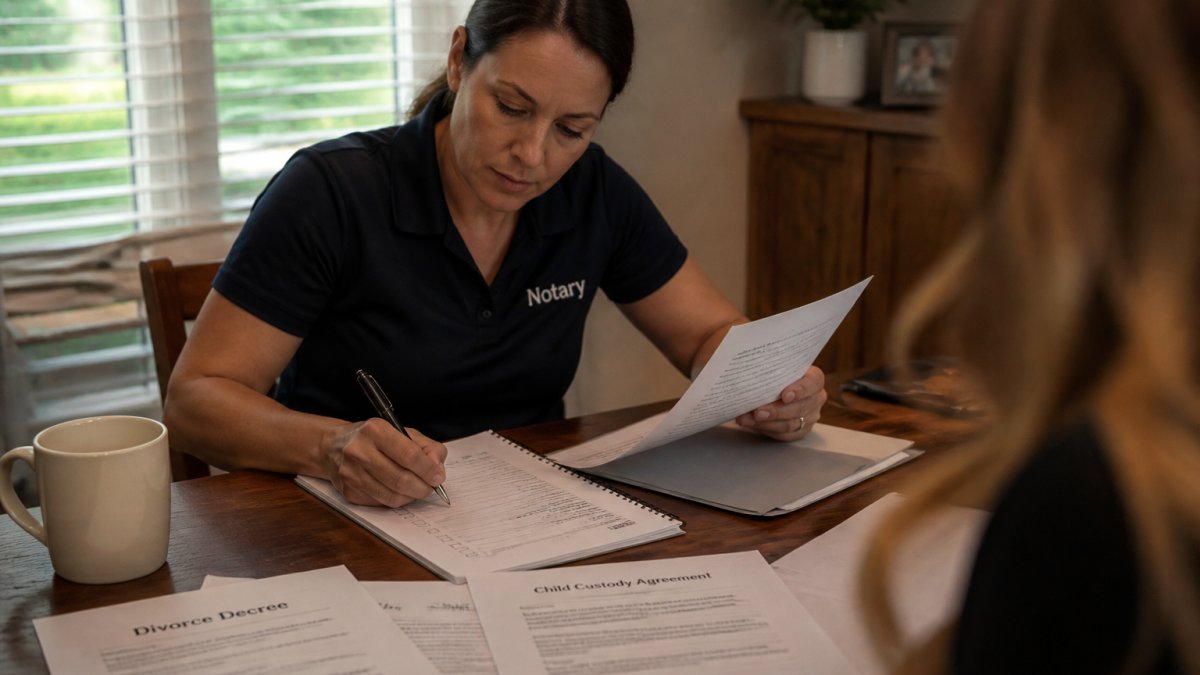
Divorce decrees and separation agreements require notarization in many jurisdictions with both spouses signing in the notary's presence. A mobile notary handles this at your home, attorney's office, or neutral location, eliminating scheduling conflicts.
Custody and child support agreements benefit from professional notarization, creating an official record that protects both parties and documents mutual consent.
On-Site Help vs. Traditional Legal Services: What You Actually Save
Comparing on-site family law services to traditional legal representation clarifies when each option makes sense and where the real savings, and risks, lie.
On-site family law services work best when both parties agree on terms, documents are straightforward, you need professional execution but not legal advice, and you've already received legal advice or document review.
Service limitations: On-site notaries do NOT provide legal advice, court representation, negotiation, review of complex arrangements, tax guidance, or modification of existing orders.
A notary verifies identity and witnesses signatures but cannot catch errors, unfair terms, or missing provisions. This is the critical distinction.
Traditional legal services are necessary when disputes exist, assets are complex, custody is contested, one party may not understand their rights, court representation is needed, or abuse/alienation is involved.
The cost difference is substantial:
- Attorney consultation (30-60 minutes): $150-$400
- Attorney document review (1-2 hours): $300-$800
- Attorney-drafted separation agreement or custody plan: $500-$2,000
- Full attorney representation for uncontested divorce: $1,500-$5,000
- Full attorney representation for contested divorce: $5,000-$25,000+ (depending on complexity and litigation length)
On-site notarization cost a fraction of these amounts: $75-$200 for notarization.
Hybrid approach: Maximum savings with legal protection
Most people use a strategic combination:
- Attorney consultation (30-60 minutes): Discuss your situation, understand your rights, and learn what documents you need. Cost: $150-$400.
- Self-help or online forms: Use court-approved forms or online legal document services (LegalZoom, Rocket Lawyer, etc.) to draft initial documents. Cost: $0-$300.
- Attorney review (1-2 hours): Have the attorney review your drafted agreement to ensure it's fair, complete, and legally sound. Cost: $300-$800.
- On-site notarization: Use a mobile notary to execute and notarize the final documents. Cost: $75-$200.
- Court filing: File documents yourself or use a document filing service. Cost: $0-$100.
Total cost: $525-$1,800 versus $1,500-$5,000+ for full attorney handling.
Realistic savings scenarios:
Scenario 1: Uncontested divorce, both parties agree
- Attorney-only: $2,000-$4,000
- Attorney review + on-site notary: $500-$1,200
- Savings: $800-$2,800
Scenario 2: Custody agreement, both parents cooperative
- Attorney-only: $1,500-$3,000
- Attorney review + on-site notary: $400-$1,000
- Savings: $500-$2,000
Scenario 3: Simple name change for child
- Attorney-only: $500-$1,500
- Self-help forms + on-site notary: $75-$250
- Savings: $250-$1,250
Scenario 4: Contested custody or asset division
- Attorney-only: $5,000-$25,000+
- On-site services alone: Insufficient; you need representation
- Savings: $0 (on-site services cannot replace attorney in contested cases)
David Booth Mobile Notary handles notarization and document preparation, letting you allocate attorney time to legal advice, negotiation, and strategy. This balances legal protection with cost control.
Conclusion
Handling family law matters efficiently doesn't require sacrificing quality or protection. On-site family law services eliminate scheduling barriers, reduce unnecessary trips, and ensure documents are executed professionally. Whether you're managing an uncontested divorce, finalizing custody agreements, or planning your estate, bringing a professional to your location simplifies the entire process.
David Booth Mobile Notary provides NNA-certified notary services throughout Tennessee and Virginia, available 24/7 for your family law needs. We handle witness verification and professional execution, giving you the support you need exactly when and where you need it. Call now to schedule your appointment and take control of your family law timeline.
Frequently Asked Questions
How much does a mobile notary cost for family law documents?
Mobile notary pricing depends on the type of document, number of signatures needed, travel distance, and whether you need same-day or emergency service. Contact a mobile notary provider directly for a current quote.
Can a mobile notary come to my home to notarize family law documents like divorce papers?
Yes. Mobile notaries can travel to your home, workplace, or care facility to notarize family law documents including divorce decrees, custody agreements, child support orders, and other court-related paperwork. This is especially helpful if you have mobility challenges, work irregular hours, or need to finalize documents quickly without a courthouse visit.
What should I bring to a mobile notary appointment for family law matters?
Bring a valid government-issued photo ID, the original documents requiring notarization, and any supporting paperwork specified by the court or attorney. Have the exact names and signatures ready as they should appear. If documents require multiple signatures, ensure all signers are present. Ask your mobile notary provider for a specific checklist when you schedule.
Does notarizing a family law document make it legally valid?
Notarization adds a layer of legal validity by confirming that the signer's identity was verified and that they signed willingly. However, notarization alone does not make a family law document legally binding. Courts still must review and approve divorce decrees, custody orders, and child support agreements. Notarization ensures the document meets procedural requirements and is admissible as evidence.