 comparison
Mobile Notary vs Bank Notary Pricing: 2026 Guide
Table of Contents
- Mobile Notary vs Bank Notary: Key Cost Differences
- Understanding State Notary Fee Schedules
- Notary Public Travel Fees and Additional Charges
- Mobile Notary Service Benefits and When to Choose Them
- Bank Notary Services: Eligibility and Real Costs
- Total Cost Comparison: Real-World Scenarios
- How to Get an Accurate Quote and Avoid Hidden Charges
- Frequently Asked Questions
Last Updated: October 5, 2026
Mobile Notary vs Bank Notary: Key Cost Differences
When you need a document notarized, two main options compete for your time and money: visiting your bank or calling a mobile notary to come to you.
Mobile notary vs bank notary pricing depends on several factors that most people overlook until they're ready to book. Your bank might offer free notarization, but only if you're a customer and your document fits their narrow eligibility rules.
The real question isn't which is cheaper in absolute terms. It's which makes sense for your specific situation. Here's how to compare them fairly.
What You Pay For With Each Service
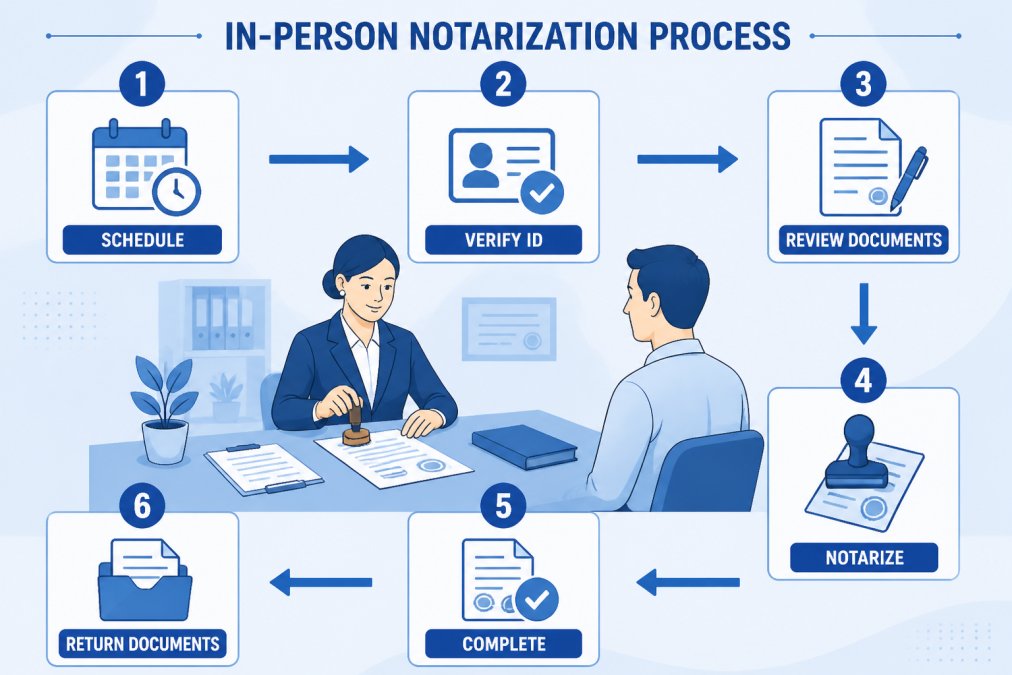
Bank notarization typically costs nothing for account holders on straightforward documents like acknowledgments. You walk in during business hours, a notary public verifies your identity, signs and stamps your paperwork, and you leave.
Mobile notary services charge for the convenience of having a notary come to your home, office, or other location. You pay a base notarization fee plus travel costs.
The real cost difference emerges when you factor in your time. A bank visit means finding parking, waiting in line, and blocking out an hour of your day. A mobile notary eliminates that friction but charges for it.
Understanding State Notary Fee Schedules
State governments regulate what notaries can charge for the actual notarial act, the part where they verify your identity, watch you sign, and affix their official stamp. These regulated fees are separate from travel charges, which notaries set themselves.
How State Regulations Cap Notarial Act Fees
Each state sets a maximum fee for a notarial act. This is the baseline cost you'll encounter whether you use a bank notary or a mobile notary. The state doesn't set a minimum, so some notaries charge less, but they can't legally exceed the state maximum.
These fees vary by the type of notarial act. An acknowledgment (where you acknowledge you signed a document) typically costs less than a jurat (where you swear under oath that the contents are true).
The key insight: when a bank charges you nothing, they're absorbing the state-regulated fee as a service to customers.
Tennessee and Virginia Fee Structures
Tennessee and Virginia both regulate notary fees, but the amounts differ. Both states allow notaries to charge for acknowledgments, jurats, and other notarial acts, with maximums set by state law. The specific dollar amounts for each act type are defined in each state's notary regulations.
When you're comparing costs between a bank visit and a mobile notary in these states, the notarial act fee is typically the smaller part of the bill. The bigger cost driver is travel.
Notary Public Travel Fees and Additional Charges
This is where mobile notary pricing becomes complicated. The state regulates the notarial act fee, but notaries set their own travel charges. That's where the real variation happens.
Mileage, Dispatch, and Travel Distance Costs
A mobile notary typically charges a base service fee (which includes the notarial act) plus mileage. Some charge per mile round-trip from their office.
If you're in the city and the notary is nearby, travel costs might add $15 to $30 to your bill. If you're 30 miles away or in a rural area, travel charges can easily exceed $50 to $100, depending on the notary's pricing structure.
Dispatch fees are another line item. If you need same-day service or call on short notice, some mobile notaries charge an expedited booking fee. This covers the cost of rerouting their schedule to fit you in.
After-hours appointments carry premiums too. If you need notarization at 9 PM on a Friday, the notary is charging more than for a 2 PM weekday appointment because they're working outside standard hours.
When Extra Fees Apply
Multiple signers on the same document mean multiple notarial acts, so you pay per signature. If three people need to sign and be notarized, that's three separate fees, not one.
Document complexity can also affect pricing. A simple one-page acknowledgment is straightforward. A loan signing package with 50 pages and multiple signature blocks is more time-intensive, and some notaries charge extra for that complexity.
Travel distance is the biggest variable. Within a 10-mile radius, travel costs stay predictable. Beyond that, they climb quickly. Rural locations often trigger higher minimums because the notary's round-trip time is longer.
Mobile Notary Service Benefits and When to Choose Them
Mobile notaries solve real problems that bank visits can't address. Understanding when those benefits justify the extra cost helps you make the right choice.
Convenience and On-Demand Availability
The primary advantage of a mobile notary is availability. Banks operate 9 to 5, Monday through Friday. If you work during those hours, taking time off for a bank visit costs you, either in lost productivity or in PTO. A mobile notary works evenings, weekends, and even holidays.
Location flexibility is equally valuable. You don't have to find parking, sit in a waiting room, or travel to the bank. The notary comes to your home, office, hospital room, or assisted living facility. For elderly clients, people with mobility issues, or anyone managing a tight schedule, this is worth paying for.
Service for Complex or Urgent Documents
Loan signings and real estate closings often require a notary who understands the documents and can handle multiple signers. Banks typically don't offer this level of service. They'll notarize simple acknowledgments but rarely handle the complex loan packages that real estate transactions require.
When you need same-day or emergency notarization, a contract that needs to close by end of business today, a mobile notary is often your only option. Banks can't reroute staff to accommodate last-minute requests. A mobile notary service can.
Bank Notary Services: Eligibility and Real Costs
Bank notarization is cheap or free, but it comes with significant strings attached.
Free or Low-Cost Notarization for Account Holders
Most banks offer free notarization to checking and savings account holders. This is a customer service benefit, not a profit center. The bank absorbs the cost of employing a notary public on staff.
Non-customers typically pay a small fee, $10 to $20 per notarial act, depending on the bank. This is still cheaper than mobile notary pricing, but you're paying for the convenience of walking in and out quickly.
The catch is that this only applies to simple documents. Loan signings, complex real estate transactions, and multi-signer packages fall outside what most bank notaries will handle.
Limitations on Document Types and Availability
Banks notarize acknowledgments and sometimes jurats, but they rarely handle loan documents, mortgage papers, or power of attorney forms that require specific expertise. If your document is outside their comfort zone, they'll refer you elsewhere.
Hours are another limitation. If your bank closes at 5 PM and you need notarization at 7 PM, you're out of luck. Weekend and holiday closures mean you can't access bank notaries when you need them most.
Availability also depends on staffing. Some branches have a notary on duty all day. Others have one notary working part-time, and you might have to wait or come back another day.
Total Cost Comparison: Real-World Scenarios
Comparing mobile notary vs bank notary pricing only makes sense when you run the numbers for your actual situation. Here's how different scenarios play out.
| Scenario | Bank Notary | Mobile Notary | Winner |
|---|---|---|---|
| One simple acknowledgment, business hours, in-city | Free (account holder) | $35-$50 | Bank |
| One simple acknowledgment, non-customer | $15-$20 | $35-$50 | Bank |
| Same-day urgent notarization, evening hours | Unavailable | $60-$100+ | Mobile |
| Loan signing, 20+ pages, multiple signers | Unavailable | $100-$200+ | Mobile |
| Rural location, 30+ miles away | Free/low cost + your travel time | $80-$150 | Depends on your time value |
| Multiple documents, weekend appointment | Unavailable | $75-$150 | Mobile |
Simple Documents, Standard Hours
If you need a single acknowledgment notarized during business hours and you're an account holder at your bank, the bank wins on cost. You pay nothing or nearly nothing. A mobile notary charges a base fee plus travel, which typically totals $35 to $50 even for a short-distance appointment.
The bank's advantage disappears if you're not a customer. Then you're paying $15 to $20 anyway, and the time cost of traveling to the bank might make a mobile notary's convenience worth the extra $15 to $30.
Complex Documents and After-Hours Service
This is where mobile notaries dominate. Banks can't handle loan signings or complex real estate transactions. If you need this service, a mobile notary is your only option. Prices range from $100 to $200 depending on document complexity and travel distance.
After-hours appointments are similar. You can't use a bank at 8 PM on a Thursday, so the comparison is moot.
Rural or Remote Locations
This scenario reveals the hidden cost of mobile notary travel. If you live 40 miles from the nearest bank and 35 miles from a mobile notary, the bank's "free" notarization suddenly requires an hour of driving. The mobile notary charges $80 to $150 for travel, but you save two hours of your time.
Whether that's a good trade depends on your hourly rate. If you're salaried and have flexibility, your time might not have a direct cost. If you're losing billable hours, the mobile notary's travel fee starts to look reasonable.
How to Get an Accurate Quote and Avoid Hidden Charges
Mobile notary pricing is transparent only if you ask the right questions. Many notaries quote a base price, then surprise you with extras.
Questions to Ask Before Booking
Always ask upfront: What is your notarial act fee? What is your travel charge, per mile or flat fee? Is there a minimum travel charge for appointments within a certain radius?
Ask whether the quote covers everything or if there are additional charges for document complexity, multiple signers, or rush service. Some notaries quote low but add $15 to $25 per signer or per page if the document is lengthy.
Confirm the service area. Does the notary serve your location, or will you be charged a higher travel fee for being outside their preferred zone?
Understanding Your Cost Estimate
A complete quote should itemize: the notarial act fee (set by state law), the travel charge (mileage or flat fee), any expedited or after-hours premiums, and the total.
Compare quotes from multiple notaries. Pricing varies, especially on travel charges. One notary might charge $30 for a 10-mile round trip; another charges $50. That $20 difference adds up.
When you need notarization, the choice between a bank and a mobile notary depends on your document type, timing, and location.
Frequently Asked Questions
Do banks charge for notary services?
Many banks offer free notarization to account holders for basic documents like acknowledgments and jurats. However, eligibility depends on your account status, and not all banks provide this service. Non-customers typically pay a fee, and banks may charge for complex documents or multiple signers. Call your bank to confirm availability and whether you qualify for free service before visiting.
Why is mobile notary pricing higher than bank notary services?
Mobile notary services charge for travel, convenience, and on-demand availability. Beyond the notarial act fee (which state law regulates), you pay travel fees, mileage charges, and dispatch costs. Banks avoid these expenses because you visit them. Mobile notaries justify premium pricing by eliminating your travel time, offering after-hours appointments, and serving locations banks cannot reach, making them valuable for urgent or complex signings.
What documents can a mobile notary handle that a bank cannot?
Mobile notaries handle the same document types as banks, but they excel with complex transactions like loan signings, real estate closings, and multi-signer agreements. Banks often limit service to simple acknowledgments and may refuse documents requiring specialized knowledge. Mobile notaries bring expertise and flexibility to your location, making them ideal for time-sensitive legal or financial documents requiring professional attention and coordination with multiple parties.
Are there state-mandated maximum fees for notary services?
Yes. Each state sets maximum fees for notarial acts like acknowledgments, jurats, and verbal oaths. These regulated fees vary by state and document type. However, state fee caps apply only to the notarial act itself; travel fees, mileage charges, and convenience premiums are separate and not always regulated. Check your state's notary fee schedule through the National Notary Association or your state's Secretary of State office to understand what portions of a quote are regulated versus discretionary.