 How-to
7 Things to Know About a Private Wedding Officiant for Elopements
Last Updated: November 12, 2026
Quick Summary
A private wedding officiant for elopements is a licensed or authorized professional who performs the legal solemnization of your marriage and can also plan and deliver a personalized ceremony at a location you choose. Elopement officiant cost typically ranges from $200 to $650, with an average of $300. Confirm the officiant's authority and witness rules with the county before booking.
- The average elopement runs about $5,800, and 89% of couples who choose one save more than $10,000.
- Custom celebrant services that include a written ceremony run $400 to $900 or more.
- A workable vow is 150 to 250 words, long enough to be specific and short enough to deliver.
- Finalize the ceremony script and vows about a week out, and bring a printed copy as backup.
- Confirm witness requirements and how the signed license gets returned with the state or county office.
Table of Contents
- What a Private Wedding Officiant for Elopements Actually Does
- Elopement Officiant Cost: What Drives the Price
- How Long Is an Elopement Ceremony, Start to Finish
- Building Your Elopement Ceremony Script and Vows
- Why a Mobile Wedding Officiant Fits Elopements
- Marriage License and Witness Rules Before You Book
- Checklist for Elopement Logistics and Interstate Nuances
- Booking Your Private Elopement Ceremony
- Frequently Asked Questions
What a Private Wedding Officiant for Elopements Actually Does
A private wedding officiant for elopements is a licensed or authorized professional who performs the legal solemnization of your marriage and can also plan and deliver a personalized ceremony at a location you choose. According to Gitnux's 2026 comparison of elopement and traditional wedding costs, the average elopement runs about $5,800, and 89% of couples who choose one save more than $10,000. At David Booth Mobile Notary, we handle both halves of that job: the legal paperwork and the ceremony itself.
Legal Solemnization vs. Ceremony Planning
The legal side is non-negotiable. Someone authorized under state law must declare you married, sign the license, and return it for recording. The ceremony side is where a private officiant earns their fee: writing a script, guiding your vows, and managing the logistics of the day. Many courthouse weddings cover only the first half. A private elopement officiant covers both, which is why couples who want a meaningful ceremony without a full wedding plan book one.
Elopement Officiant Cost: What Drives the Price
Elopement officiant cost typically ranges from $200 to $650, with an average of $300, according to Wedding Tip Calculator's 2026 officiant pricing data. Custom celebrant services that include a written ceremony run $400 to $900 or more, while private officiants in some markets quote $150 to $400. If you are comparing quotes for a last-minute ceremony, our guide to low-cost wedding services covers what to expect.
Several factors affect the total:
- Travel distance to a remote trailhead, overlook, or private venue
- Ceremony customization, including script writing and vow coaching
- Timing, since after-hours and weekend bookings often carry a premium
- Rehearsal or witness coordination, if you need either
What's Typically Included in a Quote
Ask every officiant what the fee covers before you book. A complete quote usually includes a planning call, a ceremony script, the ceremony itself, signing and returning the license, and travel within a set radius. Travel fees are the most common surprise, so scrutinize them the way you would any mobile notary travel fee before you sign.
Here is what typically moves an elopement officiant's quote up or down.
| Cost factor | What it covers |
|---|---|
| Travel distance | Remote trailhead, overlook, or private venue |
| Ceremony customization | Script writing and vow coaching |
| Timing | After-hours and weekend bookings often carry a premium |
| Rehearsal or witness coordination | Included if you need either |
| Typical fee range | $200 to $650, average of $300 |
| Custom celebrant services | $400 to $900 or more with written ceremony |
| Some private officiants | $150 to $400 in some markets |
How Long Is an Elopement Ceremony, Start to Finish
The length of an elopement ceremony depends on what you include, such as readings or custom vows, and on the time needed for arrival and paperwork. Confirm the timing for your package when you book.
Plan for the whole visit, not just the vows, and leave a buffer for license signing, witness signatures, and any photography.
Building Your Elopement Ceremony Script and Vows
A well-planned elopement ceremony script gives structure to the welcome, remarks about the couple, the vow exchange, the declaration, and the closing. Treat the script as a working template so the ceremony feels personal rather than formulaic.
A typical elopement script often follows this sequence:
- Welcome and framing (75-125 words). Name the setting and the reason you are gathered, even if the only attendees are the photographer and a witness. Example opener: "We are here, on this ridge at sunrise, because [Partner A] and [Partner B] chose each other and chose this place to say so."
- Remarks about the couple (150-250 words). Two or three specific, true details, how they met, a shared habit, a hardship they weathered. Specificity is what makes guests (and the couple) lean in; generic praise does not.
- Readings or cultural elements (100-200 words, optional). A poem, a passage, a handfasting, a sand ceremony, or a moment of silence. Keep it to one element unless the couple has a strong reason for two.
- The vow exchange (200-350 words including both partners' vows). This is the emotional center and should get the most rehearsal.
- The declaration and ring exchange (75-125 words). The formal "by the authority vested in me" language, if the state requires it, plus rings if used.
- The closing and pronouncement (50-100 words). A short blessing, the introduction of the couple, and a clear cue for the photographer.
Before drafting a script, it helps to answer a few questions: What brought you together? What do you want guests to hear? What tone fits you, formal, funny, or interfaith? Finalizing the script at least a week ahead leaves time to revise. Build in one full read-aloud pass; sentences that look fine on paper often trip the tongue, and the read-aloud is where you cut them.
Vow writing works the same way, and it is where couples stall most. A workable vow is 150 to 250 words, long enough to be specific, short enough to deliver without a page in your face. Use a four-part frame: (1) what you love about your partner, stated as a specific behavior rather than an adjective; (2) one promise about how you will show up day to day; (3) one promise about how you will handle conflict or hard seasons; (4) a closing line you can say while looking at them, not the paper.
Watch out: the two most common script failures are a ceremony that runs long because the remarks section was never trimmed, and vows that were finalized the morning of the ceremony and never rehearsed. Set a deadline of about a week out for the final script and vows, and bring a printed copy as a backup in case a phone dies or the wind takes the pages.
Why a Mobile Wedding Officiant Fits Elopements
A mobile wedding officiant can travel to your location rather than requiring you to come to a chapel or courthouse. That matters for elopements because the setting is usually the point: a ridge line, a family garden, a beach at sunrise.
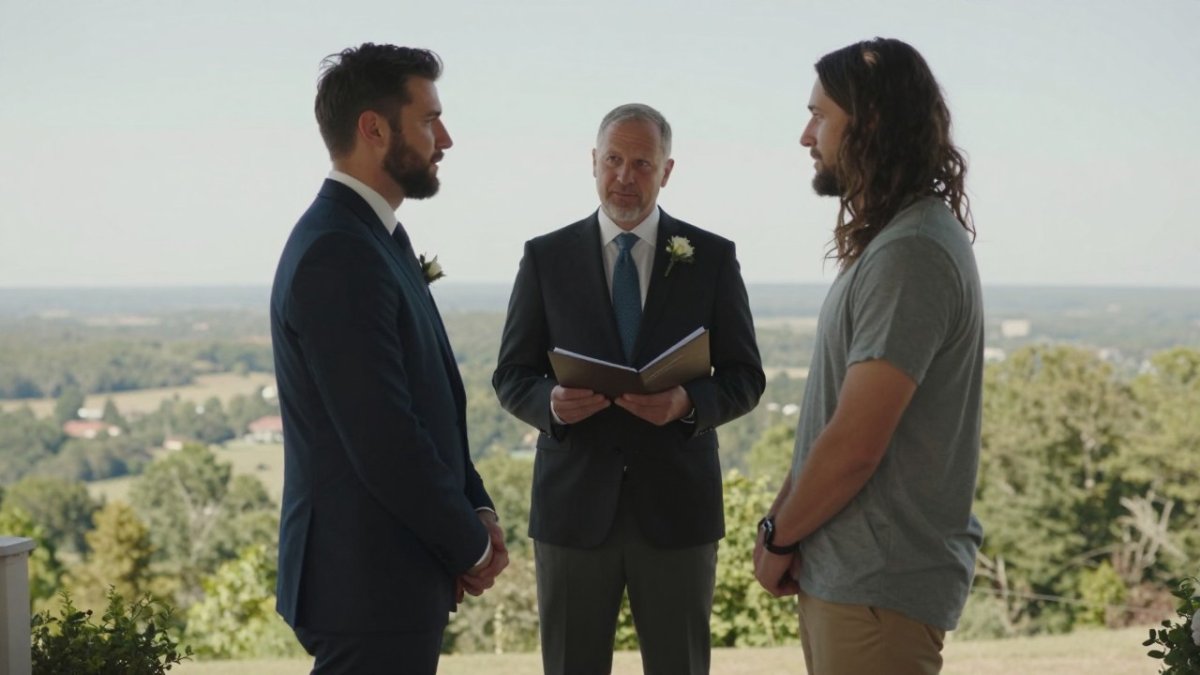
Cost and time are the practical arguments. On-site service removes travel on your end and often bundles ceremony and paperwork into one visit. For a closer look at how that works, read how on-site officiant services save time and money.
Marriage License and Witness Rules Before You Book
Marriage license rules are set by each state, and they are not optional. Every couple needs a valid license before the ceremony, and the officiant must be authorized to solemnize the marriage in that jurisdiction.
Start with the license itself. License procedures, fees, waiting periods, and expiration windows are set at the state and county level and vary. Check the current requirements with the county clerk or recorder in the county where your ceremony will take place, and plan the license around its expiration window. Confirm the current fee, waiting period, and expiration window with the issuing office, because these change.
Witness rules are the second trap. Witness requirements differ by state, so confirm the number of witnesses and any age or residency rules with the state or county office before the ceremony.
Then there is the officiant's authority. Who may solemnize a marriage is set by each state, and the categories of authorized solemnizers differ. Confirm the rules for the state where you marry before booking an officiant. The officiant's signature block on the license usually has to state the basis of authority, so the officiant needs to know which category they fall under in that state before the ceremony, not after.
Watch out: an elopement is not a rule-free wedding, and the most common failure is a license that was valid where the couple lives but was issued in the wrong county or has expired by the ceremony date.
Checklist for Elopement Logistics and Interstate Nuances
Use this checklist to keep the legal and practical pieces in order. It covers the gaps most planning guides leave out, including what changes when you cross state lines.
- Confirm your marriage license is valid and unexpired before the ceremony date
- Verify your officiant is authorized to solemnize in the state where you marry
- Confirm witness requirements and who will sign
- Ask how the signed license gets returned and recorded
- Check whether your home state recognizes an out-of-state marriage
- Book travel and lodging with a buffer around the ceremony
- Send your officiant the final script and vows a week ahead
- Confirm the meeting point and a backup plan for weather
Interstate and international nuances deserve their own line. Recognition of a marriage and name-change procedures can vary by location, so confirm the requirements where you plan to marry and where you live.
Booking Your Private Elopement Ceremony
Booking a private elopement ceremony generally involves confirming your date and location, verifying the officiant's credentials and the license rules, agreeing on what the fee includes, and planning a backup. Ask what happens if the officiant cancels, and get the answer in writing.
If you are weighing whether mobile service is worth the premium, our breakdown of whether hiring a mobile notary is worth the extra cost applies the same math. And if the mobile model is new to you, what a mobile notary public is and how it works explains the framework.
Eloping should feel simple, but the legal details still have to be right. David Booth Mobile Notary brings 24/7 mobile officiant and notary service to your location across Tennessee and Virginia, with a private wedding chapel available in Gate City, Virginia, and emergency service when timing is tight. Our team is NNA certified, background checked, bonded, and insured. Call now to confirm your date and get your ceremony on the calendar.
Frequently Asked Questions
How much does a private wedding officiant cost for an elopement?
Elopement officiant cost depends on travel distance, ceremony length, and whether you need custom scripting. For current pricing for your date and location, contact David Booth Mobile Notary for an itemized quote before you commit.
How long is an elopement ceremony?
The length of a private elopement ceremony depends on what you include, such as readings, personal vows, or a unity element. Build in extra time for photos, signing the marriage certificate, and witness signatures. Ask your officiant how long is an elopement ceremony in their typical package so your schedule matches reality.
Can a private wedding officiant perform the ceremony at a location of our choice?
Yes, in most cases. A mobile wedding officiant travels to your chosen spot, whether that is a park, a private home, a beach, or a small chapel. Confirm the location allows ceremonies and check parking or permit rules ahead of time. Ask the officiant about their travel radius and any mileage fee. Some officiants also keep a private chapel as a backup for weather, which is useful for outdoor plans in Tennessee and Virginia.
What should we ask a private wedding officiant before booking an elopement?
Ask for proof of credentials, including ordination or authorization to solemnize in your state, plus bonding and insurance. Confirm availability for your exact date and time, and whether they offer backup coverage if they cannot attend. Request a sample ceremony script and ask how much customization is included. Get the total price in writing, including travel. Finally, ask how they handle the marriage license and witness requirements so nothing stalls on the day.